Flags Nepal reference sheet
Construction notes and dimensions from our studio package — use together with Schedule 1 of Nepal’s constitution for institutional work.
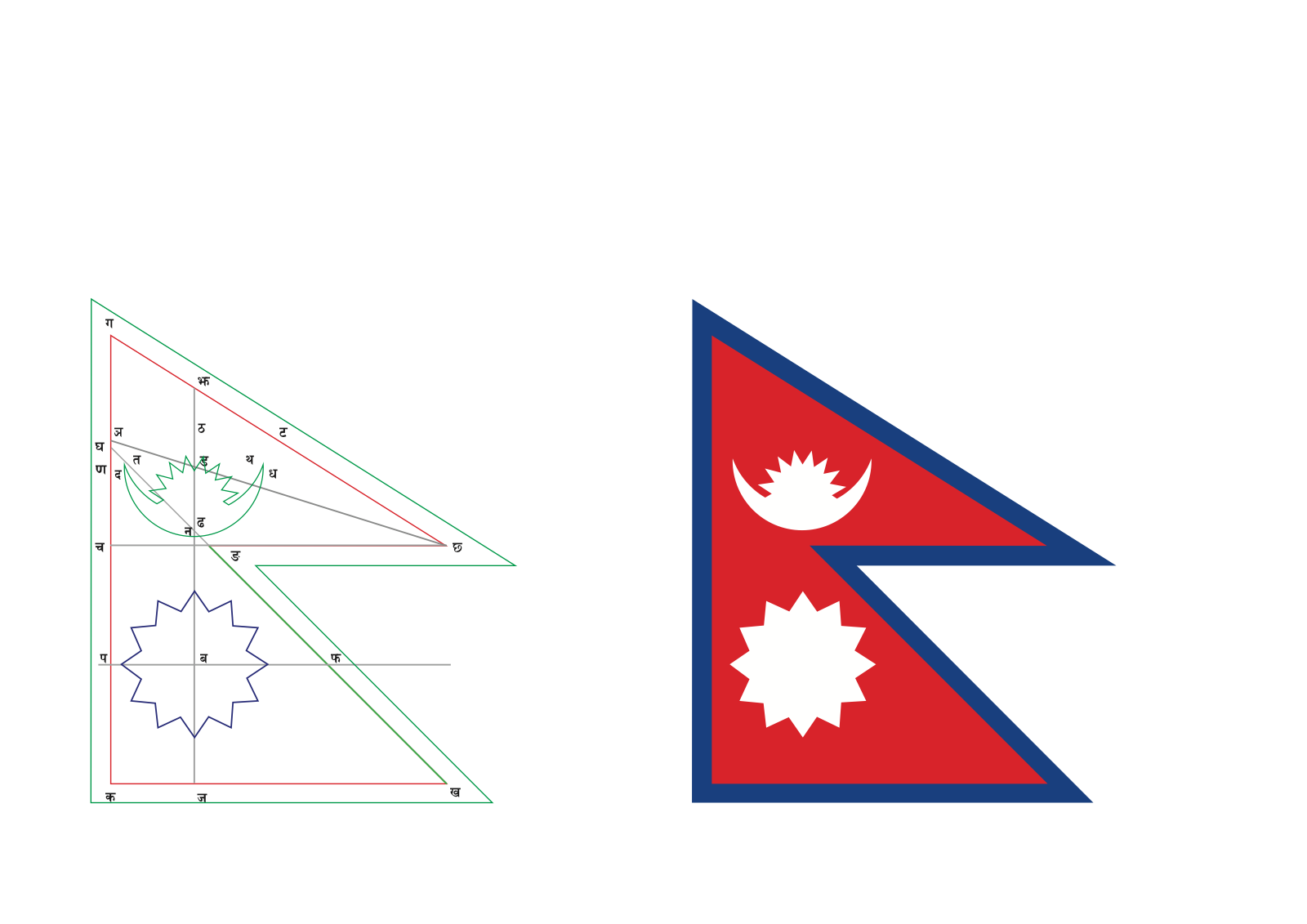
Download PDFFrom your supplied PDF — downloadable above for offline reference.

नेपालको झण्डा — इतिहास, अर्थ र आधिकारिक अनुपात
The world's only sovereign non-rectangular flag — crimson, cobalt, and lunar–solar emblems locked by constitutional geometry. This guide blends Wikipedia's Flag of Nepal article, mirrored Commons artwork, and Flags Nepal's downloadable studio sheet.
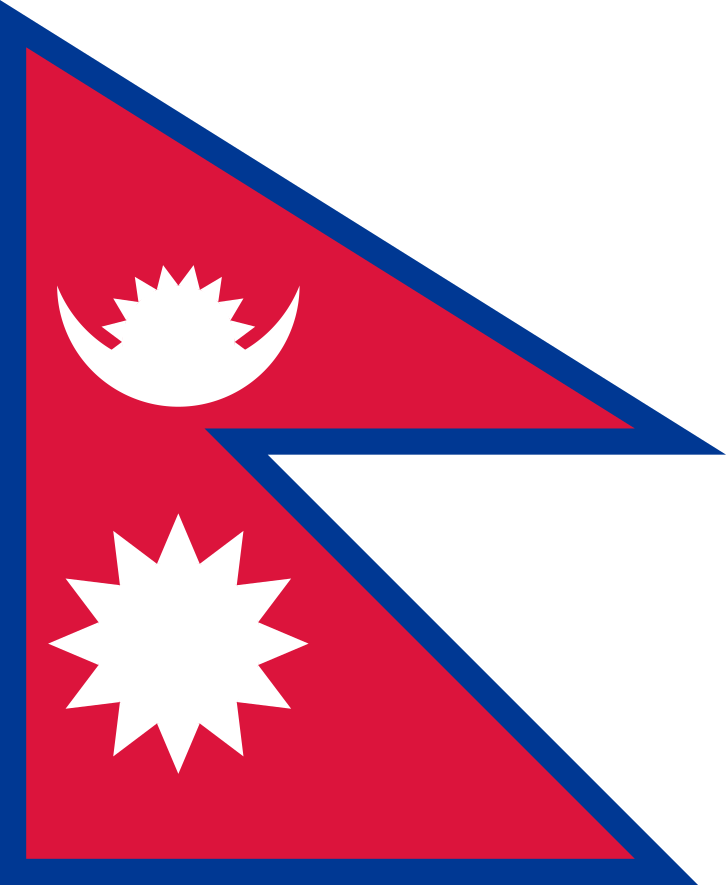
Double pennon
Unique outline
Two stacked crimson wedges with sun and moon emblems — the only national flag that is not a rectangle.
Construction notes and dimensions from our studio package — use together with Schedule 1 of Nepal’s constitution for institutional work.
SVG coded to the 1990 Schedule 1 engineering notes embedded in the SVG metadata — ideal for lossless previews.
“Every clause in Schedule 1 is a compass bearing: miss one ratio and the flag stops reading as Nepal at the United Nations wall, the Olympic tunnel, or your own office lobby.”
इतिहासको संक्षिप्त रेखाचित्र
Condensed from the Wikipedia-led chronology above — lengthen any era with archival dates as you finalize in-house research.
Regional roots
Triangular war banners were common across South Asia — compact in light wind and easy to read at distance. Hindu temple pennants (often called dhvaja) sit in the same family of forms. Nepal flew both quadrilateral and non-quadrilateral flags across its history.
Unification
The Gorkha kingdom began with a single scarlet war banner bearing deities and badges. After Prithvi Narayan Shah unified the principalities, writers describe the double pennon becoming the standard national pattern. Some historians credit later Rana rulers with giving the sun and moon human faces, weaving lunar and solar dynasty symbolism into the emblem.
Early modern
Nepal’s outward image changed with each printing: Perceval Landon’s 1928 volumes illustrate double-pennant specimens with a green outer border instead of today’s blue — a reminder that published colour is not always statute colour. Field photography from the 1920s still captures transitional details.
1962
On 16 December 1962 Nepal adopted a new constitution and, with it, the modern flag civil engineer Shankar Nath Rimal standardised for King Mahendra. The refreshed artwork merged two rival dynastic pennons, removed the anthropomorphic sun and moon faces, and spelled out exact measurements so drafters could no longer improvise the silhouette.
2015 constitution
Nepal’s 2015 constitution carries the construction forward in Schedule 1 (National Flag), replacing the kingdom-era schedule with the federal republic’s official method. For courts, embassies, and exporters, that schedule — not a random PNG export — remains the reference plane.
रङ र प्रतीक
Multiple readings coexist — we list the encyclopaedic summaries most often quoted in classrooms and diplomacy.
Field
Readers usually hear “bravery” first, but encyclopaedic accounts also tie the red to the national rhododendron and to everyday arts and crafts palettes across the country.
Border
The azure frame signals peace and harmony — the cool counterweight to the fiery interior that tourists recognise from prayer flags to storefront paint.
Moon & sun
Popular readings pair the moon with calm / purity and the sun with labour / resolve. Alternate modern glosses map the pair onto Hinduism and Buddhism, or onto the climate contrast between the snowy Himalaya and the warm Terai.
Perpetuity
Including both luminaries telegraphs the hope that Nepal lasts as long as celestial lights — a poetic line often repeated in reference works alongside the drier legal description of twelve solar rays and sixteen lunar rays (eight visible).
ज्यामिति र अन्तर्राष्ट्रिय प्रयोग
When you follow Nepal’s geometric construction verbatim, height : maximum width settles at an irrational value ≈ 1 : 1.21901033… catalogued as OEIS sequence A230582 — unusual for flags, poetic for classrooms.
The crimson double-pennon alone fits a neat 3 : 4 bounding box; the irrational step appears once the stipulated blue border envelopes the assembly.
Global events routinely force rectangular conformity: Rio 2016 often printed Nepal on white backdrops so rigging clamps matched everyone else’s hardware, whereas Tokyo 2020 manuals explicitly singled Nepal out for height-aligned exceptions.
Statute text: Wikipedia — Aspect ratio (with primary citations) and OEIS A230582.
विकिमिडिया कमन्स · ऐतिहासिक दृश्य
Raster and vector mirrors stored locally for fast delivery; always follow the Commons licence (typically public domain or CC BY-SA) when redistributing derivatives.
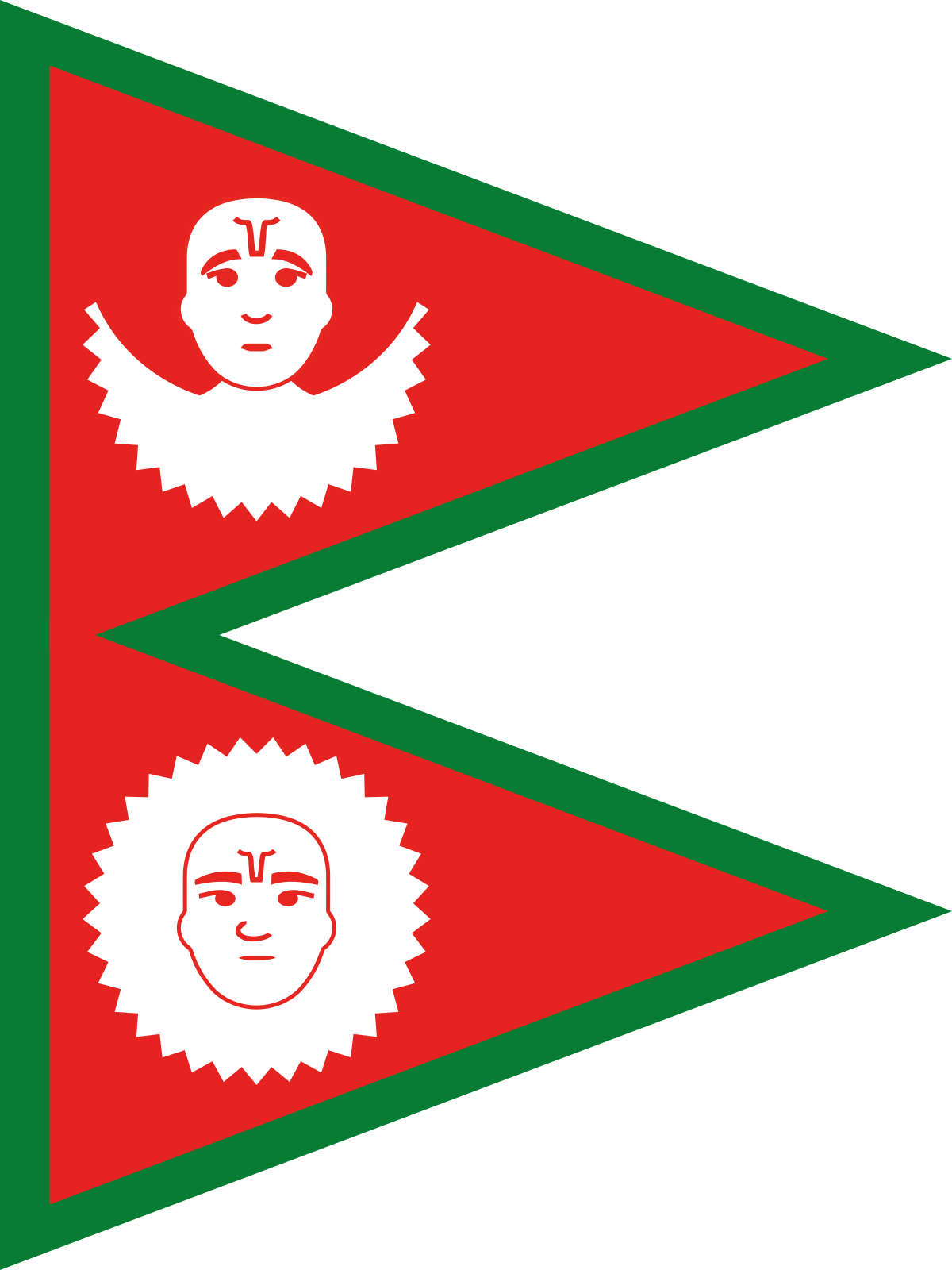
Specimen with facial sun and moon before the 1962 modernisation.
View file on Wikimedia Commons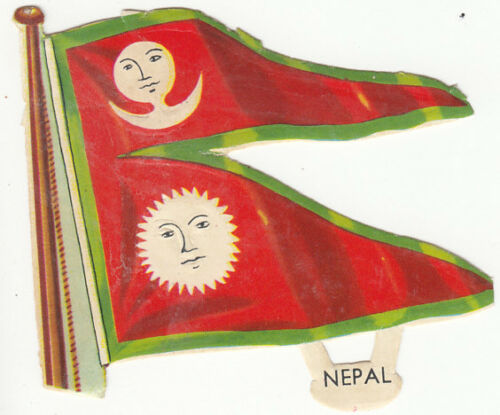
Field photograph published in early travel literature — note fabric drape, not statute lines.
View file on Wikimedia Commons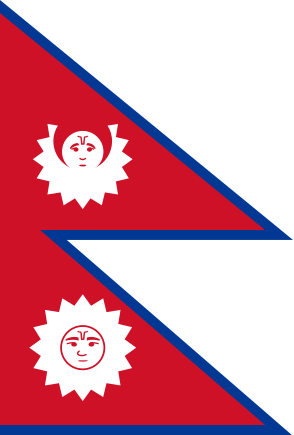
Long-form variant retained facial emblems until the December 1962 standard.
View file on Wikimedia Commons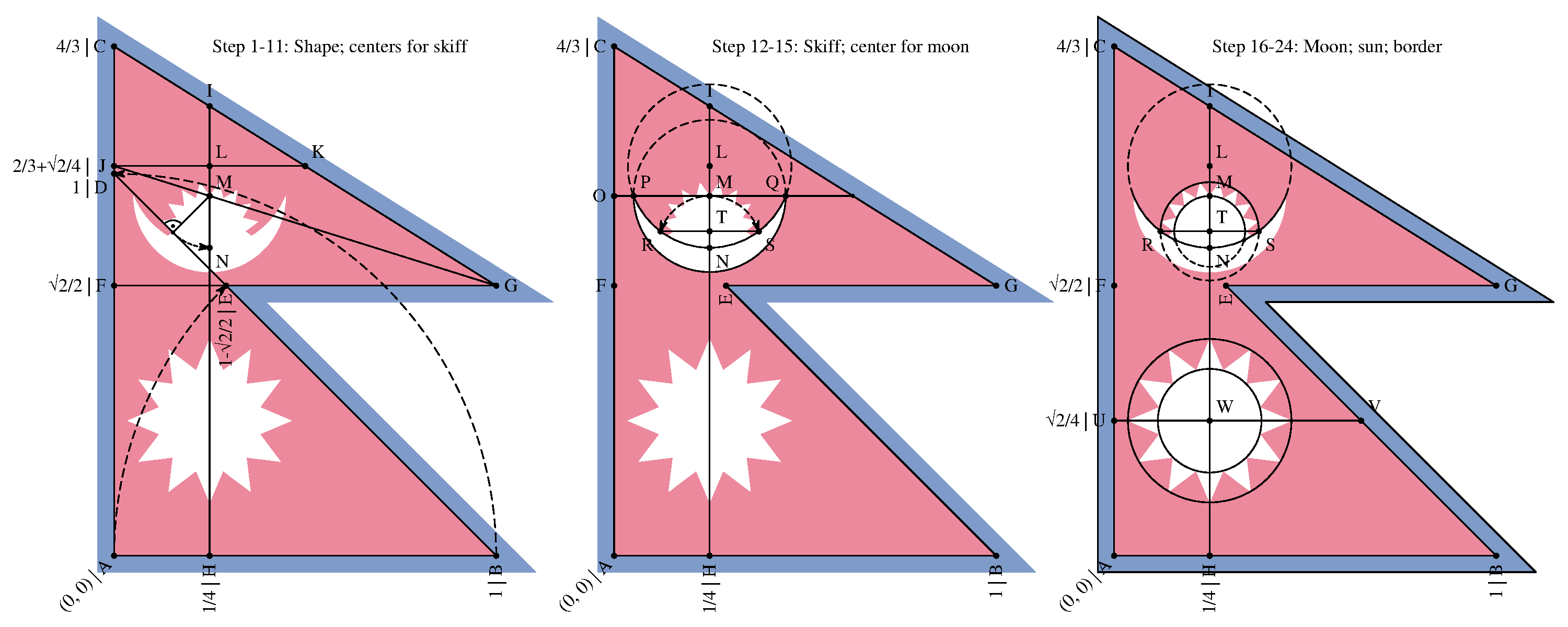
Educational schematic showing how wedges and borders compound — compare to Schedule 1 coordinates.
View file on Wikimedia CommonsBands we quote daily in Bagbazar — every size still honours the same aspect when artwork is prepared from Schedule 1 sources.
5 to 9 inch formats with proportion-safe scaling on stands.
2–5 ft systems with reinforced hems and hoist patches.
Fabrics chosen for gust load plus double-stitched fly ends.
अब उत्पादनतर्फ
Send finish sizes and quantities — we'll reconcile artwork with statutory geometry before any fabric ships.